
Welcome to the first update from Trailblazers Thrive Together (T3) at Oklahoma City Community College (OCCC). As program director, I’m excited to watch our first cohort begin this journey. T3 is a nonresidential inclusive postsecondary education program, and what sets it apart starts with where it begins: inside the Gray Frederickson Department of Digital Cinema.
While that pairing might look like coincidence, it’s a fitting tribute to the department’s namesake.
Gray Frederickson is best known for producing films like The Godfather Trilogy, Apocalypse Now, The Outsiders, and UHF. Later in his career, he brought that experience home to Oklahoma, building the filmmaking infrastructure behind OCCC’s Digital Cinema Production (DCP) program, now recognized as a Top 30 Film School in the U.S. and Canada for five consecutive years.
Gray’s vision was straightforward: train local students for professional film sets and build a workforce pipeline for Oklahoma’s growing film industry. He couldn’t have known how personal that infrastructure would eventually become.
Gray was also a father to a son with autism. Like many parents, he understood the challenges of the transition to adulthood and his desire to help his son find personally meaningful opportunities. The department he built to train Oklahoma’s film workforce became an opportunity for his own son, who completed the program himself.
Without knowing it, Gray created a space for storytellers that would grow into something more: a program that welcomed students with disabilities and opened a path to inclusive postsecondary education. Today, that same DCP program underpins a new cohort of learners pursuing filmmaking through T3.
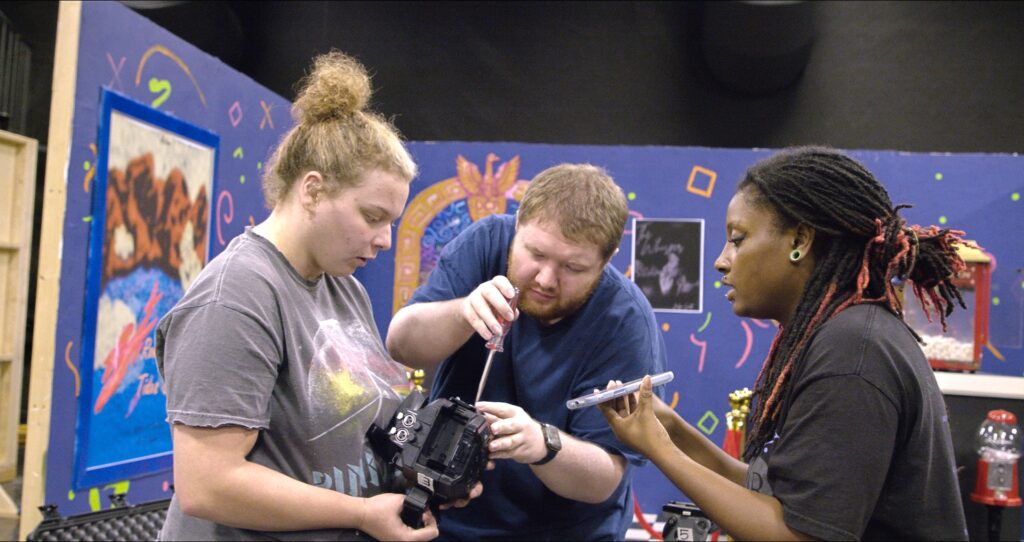
Historically, people with intellectual and developmental disabilities have been subjects in film and media, documented and observed through the lens of neurotypical directors. We’re doing something similar at OCCC: producing a documentary about this shift in accessibility. However, we’re changing the lens, capturing the moments our students move from subjects to filmmakers, working behind the camera and mentoring the next cohort of creatives.
As students work toward their Certificate of Mastery in Digital Cinema Production, they’re learning technical skills while shaping their own narratives. We’re handing them the camera, turning those skills into tools for self-advocacy, self-determination, and authorship.
Filmmaking and inclusive education share something important: interdependence. No one makes a movie alone; every crew role contributes to the final product. In class, T3 students work side by side with traditionally enrolled students. It’s natural inclusion, built around a shared creative goal.
Gray Frederickson left an incredible legacy of Oklahoma filmmaking, one that continues to grow under Sean Lynch, the program coordinator and a Gray protégé. But watching this cohort take ownership of their education and tell their own stories, on their own terms, extends that legacy in a way that films alone never could.